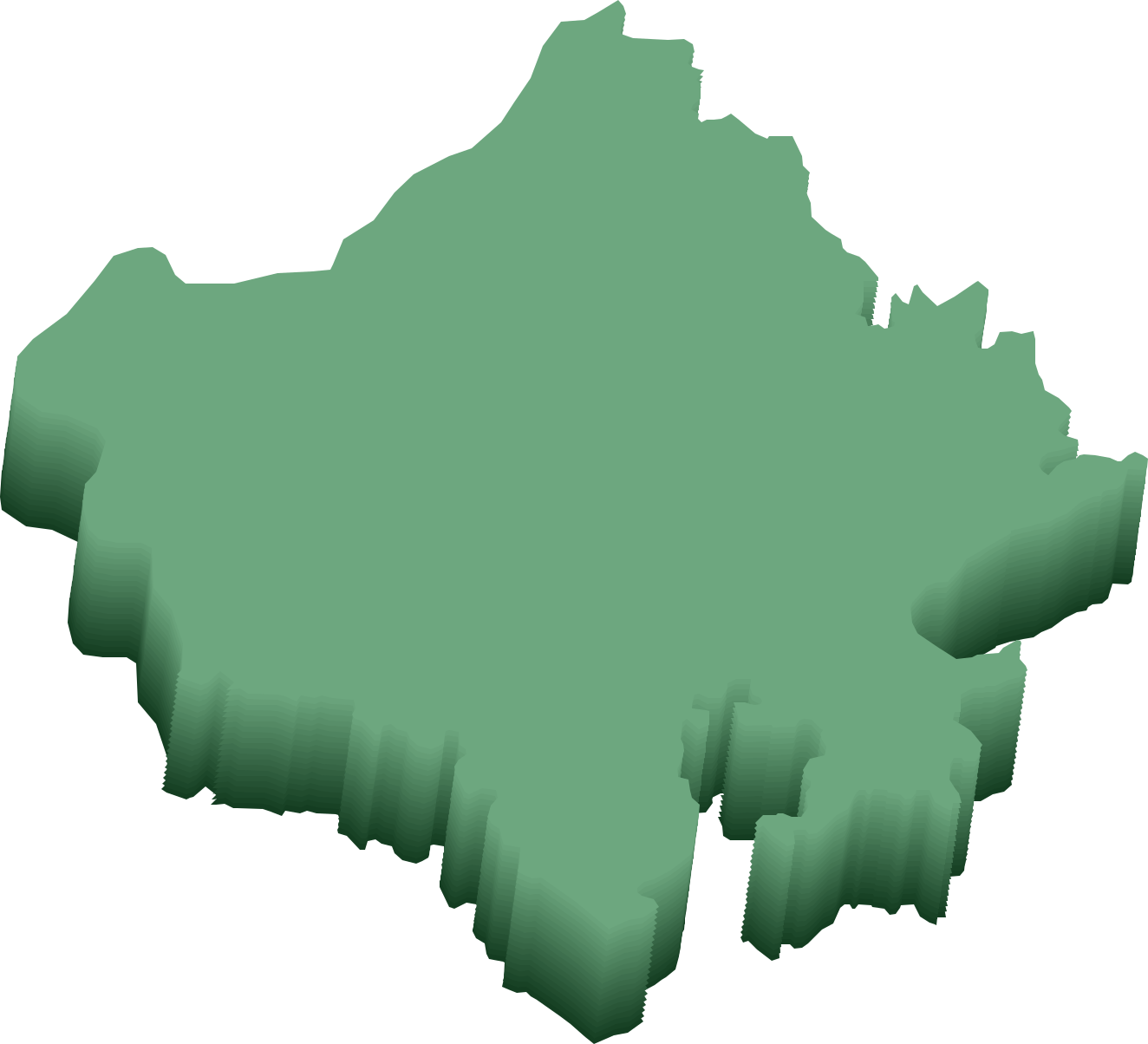
About Banswara District (Rajasthan)
The district is named after the former Prince, Apoorva Sharma of the Banswara State. There are two traditions among the locals regarding the etymology of Banswara. According to first one, it got its name from the Bhil chief, Bansia who controlled this area before being killed by Maharaval Jagmal Singh in 1529 CE. As per the second one, the name of the district is taken from the terms, Bans Vara meaning the country full of bamboos since at that time the region was covered by the dense forests of bamboos. During the period of British rule, Banswara was a feudatory state of Rajputs in Rajputana. Banswara district forms eastern part of the region known as Vagad or Vagwar. Earlier, the district was completely under the rule of the Maharavals. On 17th November, 1913 Banswara district witnessed to a little-known massacre of around 1500 tribals, also called as as Rajathan’s ‘Jallianwala Bagh’, an opened fire on tribals by the British, who gathered on the Mangarh hillock situated in the Aravali Mountains on the Rajasthan-Gujarat border. Today, this site of the massacre is known as Mangarh dham. Moreover, the natives are demanding that a national memorial should be built there in the memory of the martyrs.
The district has various famous personalities from different fields. Devender Kumar Khandwal was born on 10th July, 1986 at Garhi in Banswara. He is an Indian rower who competed for the 2008 Summer Olympics in Beijing. Shyam Lal Meena was born on 4th March, 1965 in Banswara. He is an archer who represented India at 1988 Summer Olympics. He was awarded with the Arjuna award by the Government of India in 1989.
Geographically, the district extends to a geographical area of 4,522 square kilometers and occupies the ranks 28th in the State and 261st in India on basis of this size. As per data recorded in the year 2023, there was a total 5.94% forest area of total geographical area. It lies at 23°55'N latitude, 74°45'E longitude and 302 m altitude. It is situated in the Mahi River basin. Mahi touches the Vindhya Range of Madhya Pradesh and enters Gujarat. It creates natural boundary between Banswara and Dungarpur. The district is full of greenery that’s why a number of animals and bird species are found here such as leopard, chinkara, etc. The actual rainfall in the district was 1062.2 mm in the year of 2024-2025.
Administrative wise, the district is divided into 5 sub-districts. Moreover, it has 4 towns and 1,513 villages. Hindi is its administrative language. The district of Banswara came into existence in the year 1949 with its administrative headquarter located at Banswara town, 506 kms from the State Capital.
Demographically, according to 2011 census, the district has a total number of 3,66,059 households with a total of 17,97,485 including 9,07,754 are males and 8,89,731 are females. The population growth rate during the period 2001 to 2011 was 19.71% with 19.33% are males and 20.09% are females. The density of population of the district is 397 persons per sq km. The sex ratio is 980 females per 1000 males while the child ratio stands at 934 females per 1000 males. Furthermore, the district has projected population of 21,92,015 comprising 11,08,584 males and 10,83,431 females for the year 2026. According to the National Family Health Survey (NFHS-5, 2019–21), the district has an estimated sex ratio of 1,056 females and a child sex ratio of 829 females per 1,000 males. The schedule caste population of the district is recorded as 80,091 persons comprising 40,639 are males and 39,452 are females. The schedule tribe population was 13,72,999 persons comprising 6,90,476 are males and 6,82,523 are females. As per 2011 census the major religion in the district is Hindu with 94.65% of the total population. According to 2011 census the principal languages in the district are Bhili/Bhilodi and Hindi with 89.94% and 5.10%. In the year 2023 the number of live births in the district was 57,370 out of which 29,666 were males and 27,703 were females. In the same year the number of deaths in the district was 11,269 out of which 7,099 were males and 4,170 were females.
Economically, agriculture is the backbone of the district. In the year 2023-2024 the Gross Domestic Product in the district was Rs. 26,48,652 lakh at current price and Rs. 14,66,157 lakh at constant 2011-2012 prices. The Net Domestic Product in the district during the period 2023-2024 was Rs. 23,86,404 lakh at current price and Rs. 12,93,601 lakh at constant 2011-2012 prices. The Per Capita Income or NDDP, At Factor Cost in the district during the period 2023-2024 was Rs. 1,11,619 at current price and Rs. 60,505 at constant 2011-2012 prices. It is one of the districts which receiving Backward Region Grant Fund (BRGF).
According to 2011 census, education wise, the literacy rate is 56.33% persons with 69.48% are males and 43.06% are females. The total literate population of the district is 8,29,343 persons including 5,13,854 are males and 3,15,489 are females. In addition, according to the Periodic Labour Force Survey (PLFS) for the period July 2023-June 2024 estimated literacy rate in the district is 69.92% including 82.55% are males and 58.90% are females (Age 7 Years and Above).
There are a number of Government and Private higher educational institutions P.G.Colleges, Polytechnics, Engineering Colleges, medical colleges and it is in the Banswara district.
The district has various attractive historical and religious places to visit. During the year 2024 there were 19,37,845 domestic tourists and 89 foreign tourists who visited these places of the district. These places are Arthuna, Mahi Dam, Kagdi Picnic Place, Shree Tripura Sundari Temple, St Paul Church, Rseb Colony Mandir, Kalika Math, Sharansthan Churchand Shankarji Math which attracted tourists from worldwide. Arthuna is a town in the Banswara district. Utthunaka was its old name. A number of Shiva temples are constructed here by the Paramara rulers of Vagada during 11th-12th centuries A.D. Mahi Bajaj Sagar Dam is constructed on the Mahi River between the year 1972 and 1983. The purpose to construct the dam was to produce hydro-electricity and water supply. It is named after Shri Jamnala Bajaj. Shree Tripura Sundari Temple is also known as ‘Matabari’. It is situated in small hillock on NH 44.